The Health Promotion Department recently celebrated Global Handwashing Day, which takes place every year on October 15th. During the celebration, we promote hand washing with soap as an easy and affordable way to save lives by preventing pneumonia, diarrhea, and malnutrition, three conditions that are especially dangerous for children. Mali Health community health workers encourage families enrolled in our programs to wash their hands with soap throughout the year, but Global Handwashing Day is our opportunity to spread this important message to families we wouldn’t normally reach.
The theme for 2017 was “Our Hands, Our Future.” Mali Health recognized the occasion by hosting two public educational events: one on October 14th in Kalabambougou, where hundreds of women participate in our Savings for Health program; and the other on October 20th in Sikoro, where we engage community members in all three of our programs to improve the health of women and children. Between the two events, 1,100 people joined in the festivities.
We focused on promoting hand washing with soap at three critical times: 1) after using the restroom, 2) after changing a child’s diaper, and 3) before touching food. Two of our Quality Improvement coaches, Dr. Sogoba and Dr. Bathily, demonstrated proper hand washing techniques to the crowd, and our emcee Abdou Touré, Mali Health’s media expert, kept the crowd engaged and entertained between activities. Those attending answered trivia questions about hand washing and won hand washing kits, complete with wash basins and several bars of soap.
We were grateful to be joined by representatives from Mali’s Ministry of Women, Children, and Family Affairs and the Ministry of Social Development, Humanitarian Action, and Economic Solidarity; their participation both strengthens Mali Health’s relationship with important actors in maternal and child health in Mali and provides an opportunity for community members to meet and share their thoughts with their government.
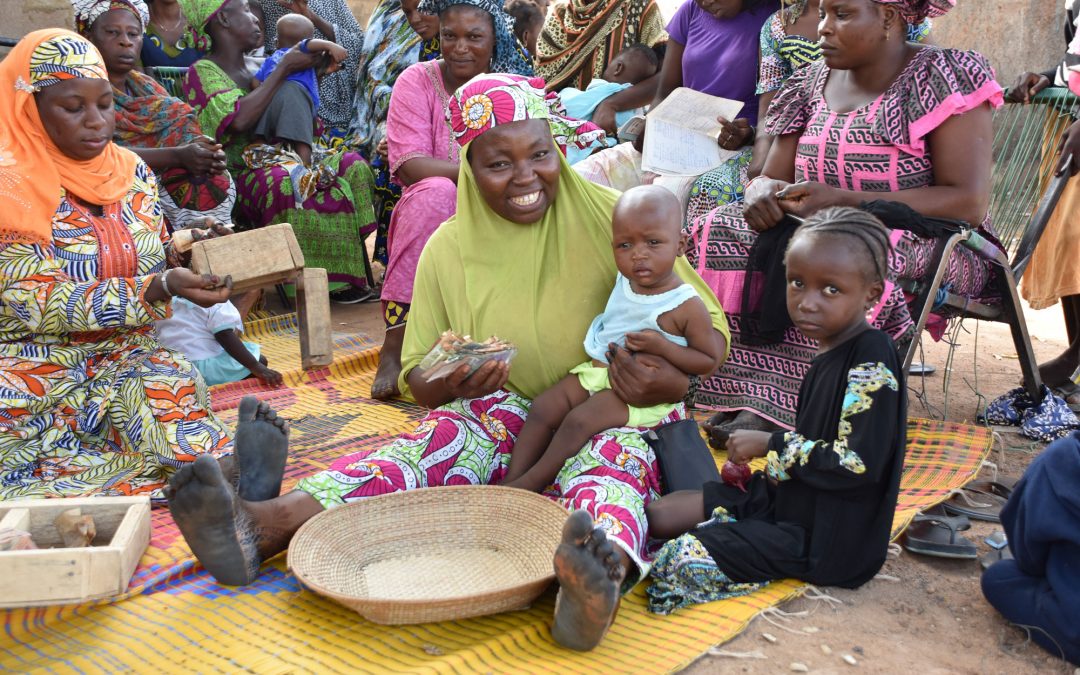
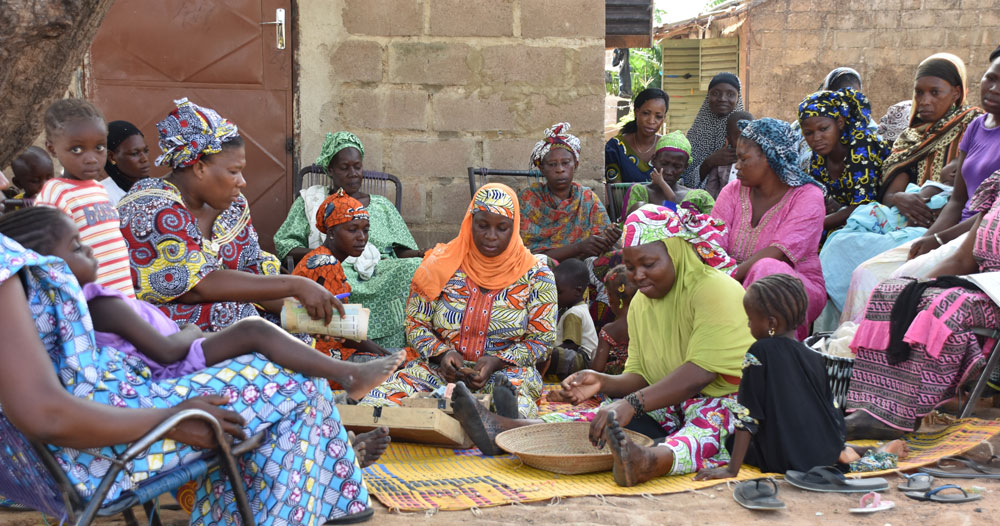
It’s late afternoon and women in Kalabambougou begin gathering for their weekly savings group, in the shade of an old moringa tree. Korotoumou Camara, 25, is there with two of her six children. She is steeping the first round of sweetened green tea for the group’s members. There are freshly roasted peanuts for sale and another woman is selling chunks of juicy watermelons. One group member braids another’s hair, and a young girl is hanging brightly colored clothes on the line to dry. This is where the members of Ben Kadi (mutual understanding) and Yelen (light) meet to save for their future needs. The group has two names because there are two things the women save money for: healthcare and small business activities.
Korotoumou is the group’s treasurer. When she isn’t meeting with the other women, she is busy with her small business selling vegetables at the nearby market or doing the never-ending work to keep her home functioning (cooking, cleaning, minding the kids). Her oldest child is eleven and her youngest is the nine-month-old girl in her lap commanding her fullest attention. She thinks education is important, so her five school-aged children are all enrolled at the nearby public school. Korotoumou and her husband, a local brick mason, had limited education when they were younger. He attended a traditional Islamic school, or madrassa, for eight years and she attended a public school until grade 5.
Korotoumou counts her group’s weekly savings as group members observe
Korotoumou was in a savings group before Mali Health introduced the idea of adding a health savings aspect. She says that contributing members feel a new sense of ownership for their family’s health needs. Before the health savings group, when one of her children required a visit to the doctor, she was unsure how she would pay for the visit and any medicines. She did not like asking family or friends for a loan because it made her and her husband feel embarrassed. Now, with the ability to take a loan from her savings group, they feel a sense of pride in being able to do for themselves what so often they had to rely on others for.
There was a health center built in Kalabambougou a few years ago, but it never opened. There is a solar-powered water tower that is empty and beginning to rust. A maternity ward with gurneys and delivery areas are collecting dust and cobwebs. The grounds serve as a temporary farm field for the family tasked with caring for the vacant health center until whatever local political dispute preventing its opening is resolved. Korotoumou shakes her head and laughs when talking about the unopened health center; she doesn’t think there’s anything she can do about it. Though, it would be convenient to have a closer health center. The closest Mali Health partner is over three miles away, so she uses the health center in the next town.
When one of Korotoumou’s children falls ill, she knows it immediately. Instead of running around playing with friends, she says they remain at home asking to sleep and lay down. At this is telltale sign, she now goes to the health center with confidence that she can afford the visit and treatment. She and her husband still wait to see if their symptoms clear up on their own, but she doesn’t wait for her children because she knows they are at greater risk and require timely treatment. The most frequent illness the family encounters is malaria, especially during the rainy season when the mosquito population booms. She and her husband still use traditional herbal medicine to treat less severe cases of malaria because it is cheaper than western medicine, and in their experience, just as effective.
The institutions that Korotoumou and her family rely on are fragile and it is difficult for her to feel secure in their future. The fear of not being able to provide for their children’s health needs used to keep her up at night. But with the support from her savings group, she can now rest a little easier. The collective nature gives her confidence that her community cares and it instills in her a feeling of agency. She knows she is contributing to better health – not just for her children, but many other children in Kalabambougou.
About Kalabambougou
Kalabambougou is a peri-urban community not far from the busy streets of Bamako’s city center. After leaving the paved roads behind, drivers go from dodging the moto bikes that weave in and out of traffic to skirting the car-sized pot holes formed by the deluge of the rainy season. Residents have recently filled potholes with large boulders that they will smash into smaller pieces with sledgehammers. It’s daunting work, made more intolerable by the relentless heat and humidity. But maintenance of these dirt roads is vital because they ensure access to Bamako, the markets, and the closest health center.

 The theme for 2017 was “Our Hands, Our Future.” Mali Health recognized the occasion by hosting two public educational events: one on October 14th in Kalabambougou, where hundreds of women participate in our Savings for Health program; and the other on October 20th in Sikoro, where we engage community members in all three of our programs to improve the health of women and children. Between the two events, 1,100 people joined in the festivities.
 We focused on promoting hand washing with soap at three critical times: 1) after using the restroom, 2) after changing a child’s diaper, and 3) before touching food. Two of our Quality Improvement coaches, Dr. Sogoba and Dr. Bathily, demonstrated proper hand washing techniques to the crowd, and our emcee Abdou Touré, Mali Health’s media expert, kept the crowd engaged and entertained between activities. Those attending answered trivia questions about hand washing and won hand washing kits, complete with wash basins and several bars of soap.